
System Feasibility & Case Study Comparison
Evaluating whether a geothermal heat-pump system can successfully prevent ice formation at YYC, supported by real-world evidence from Oslo–Gardermoen Airport.

Will a Heat-Pump System Clear Ice at YYC?
A geothermal-only system at YYC cannot deliver enough heat for anti-icing because groundwater temperatures in the Paskapoo Formation (4–11 °C) are too low. When paired with a heat pump, however, the system becomes technically feasible for critical runway zones such as touchdown areas, takeoff paths, and high-braking segments.
Heat pumps make the system work by:
• Increasing supply temperatures to 25–35 °C, creating the ΔT needed for surface heating.
• Allowing realistic pipe spacing (15–30 cm instead of 7 cm)
• Reducing geothermal load by ~70%, making a borehole system viable.
Oslo Airport Case Study Comparison
Oslo–Gardermoen Airport operates one of the world’s largest geothermal runway heating systems, using ATES and heat pumps to deliver 28–35 °C fluid to hydronic pavement pipes. Its success provides real-world validation for the feasibility of a similar system at YYC.


Why Oslo’s System Confirms Feasibility for YYC
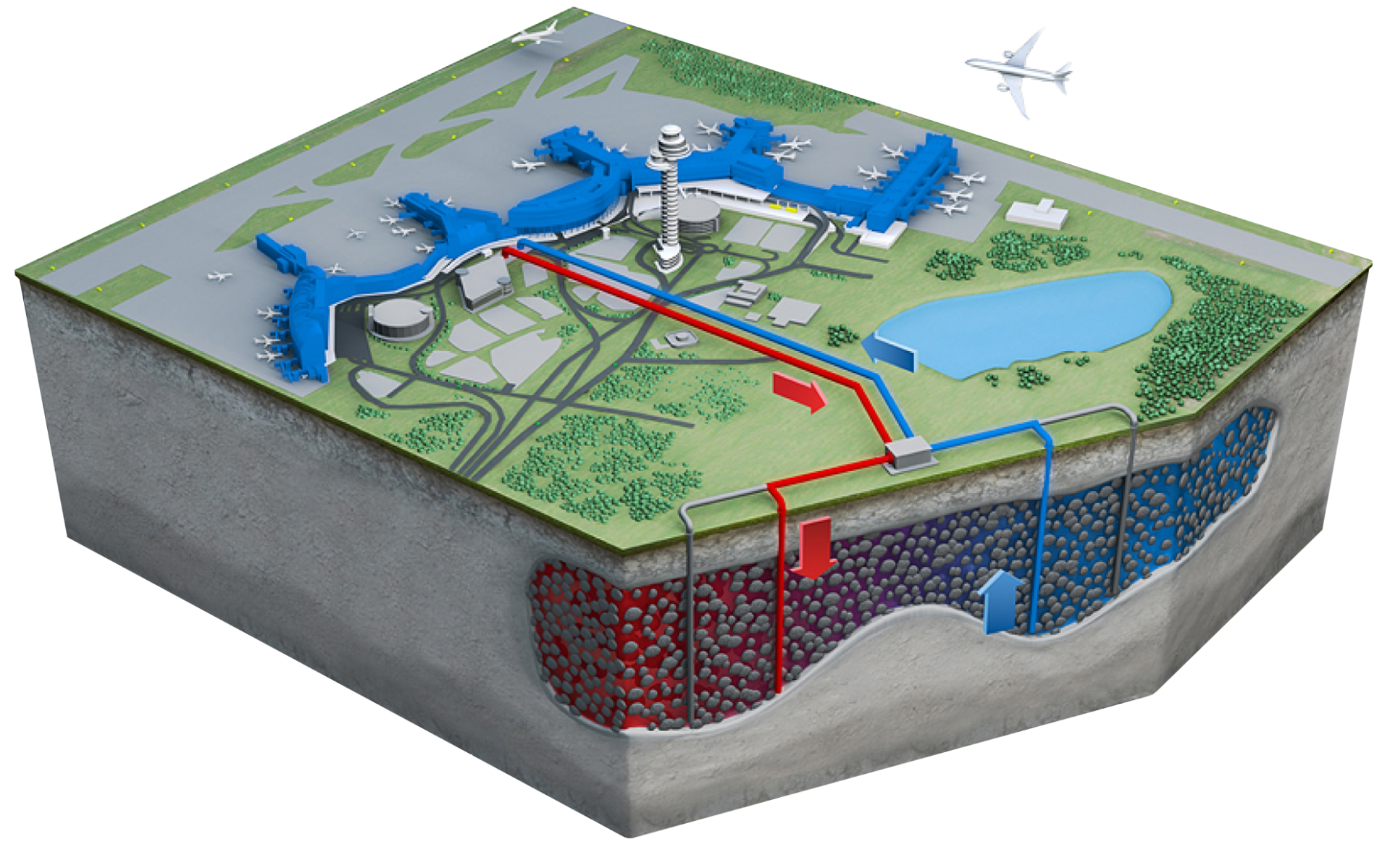
Oslo–Gardermoen Airport provides a real-world example of how geothermal energy, when paired with heat pumps, can successfully prevent ice on airport surfaces. Oslo uses an ATES geothermal system and heat pumps supplying 28–35 °C fluid to hydronic pipes installed beneath aprons, taxiways, and critical movement areas.
Key similarities to YYC:
• Both airports experience winter temperatures near 0 °C with frequent freeze–thaw cycles.
• Both rely on low-temperature groundwater (8–12 °C in Oslo; 4–11 °C in YYC).
• Both require heat pumps to raise geothermal heat to effective anti-icing temperatures.
• Both use similar design logic: surface heat flux, pipe spacing, thermal resistance, and heat-pump boosting.
Oslo’s proven success shows that YYC can adopt a similar targeted geothermal anti-icing strategy for its most critical runway zones.
Why Calgary Cannot Use ATES Like Oslo
Although Oslo’s system uses ATES (Aquifer Thermal Energy Storage), this approach is not feasible at YYC because the Paskapoo Formation does not meet the geological conditions ATES requires.
ATES stores warm and cold groundwater in separate wells and relies on very specific aquifer properties to keep the stored heat stable (Abdulla et al., 2018; Dickinson et al., 2009).
.
ATES Requirements
(Sommer et al., 2013)
-
Hydraulic conductivity ~1.2 m/day (consistent, predictable flow)
-
Low hydraulic gradient (so stored heat does not drift away)
-
Total Dissolved Solids < 500 ppm to prevent scaling and clogging
Why the Paskapoo Formation Fails These Criteria:
- Variable hydraulic conductivity: Heat would move unpredictably and could not be reliably stored (Grasby et al., 2010).
-
High TDS levels: Groundwater chemistry exceeds ATES limits, causing scaling and maintenance issues (Sommer et al., 2013).
-
Unsuitable near YYC: Even where conductivity is acceptable, aquifer variability makes large-scale seasonal storage unstable (Barker et al., 2011).
-
A high or inconsistent gradient means: the stored warm water moves away from the well, energy is lost and the system becomes unreliable.
The Paskapoo Formation is too geologically variable for ATES. Its inconsistent hydraulic conductivity, higher TDS, and unfavorable hydraulic gradients mean stored heat would drift or cause scaling issues.

Why a Closed-Loop Heat Pump System Is the Feasible Solution for YYC
Because ATES is not compatible with Calgary’s geology, YYC needs a system that does not rely on groundwater flow or chemistry. A closed-loop borehole geothermal system paired with heat pumps provides that stability.
Closed-loop systems circulate fluid through sealed pipes, avoiding problems caused by the Paskapoo Formation’s variable hydraulic conductivity and high TDS. Heat pumps then raise the ground temperature to 25–35 °C, supplying the ΔT needed for effective anti-icing.
Together, this design delivers consistent and reliable heating for YYC’s critical runway zones during winter.
